

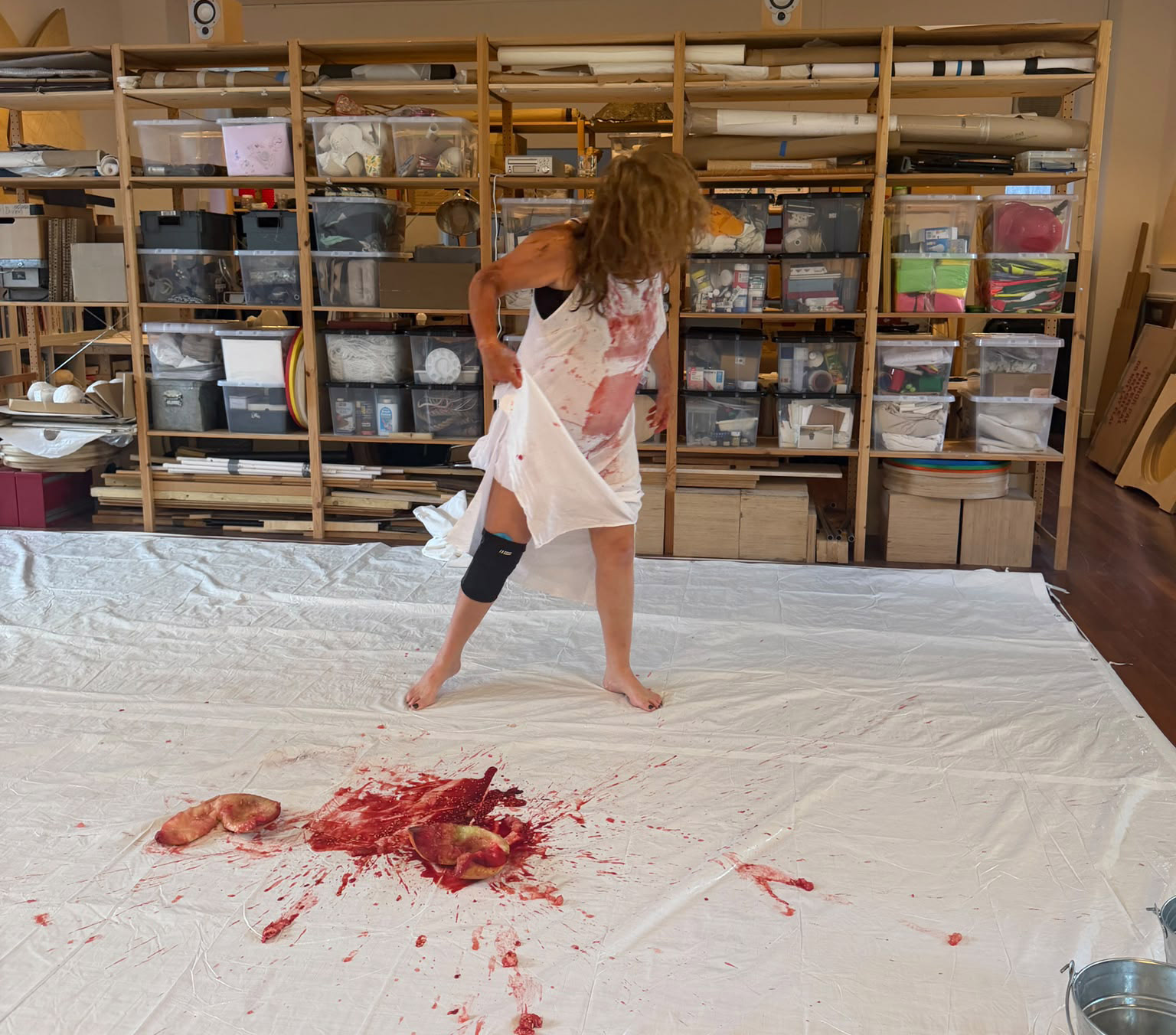
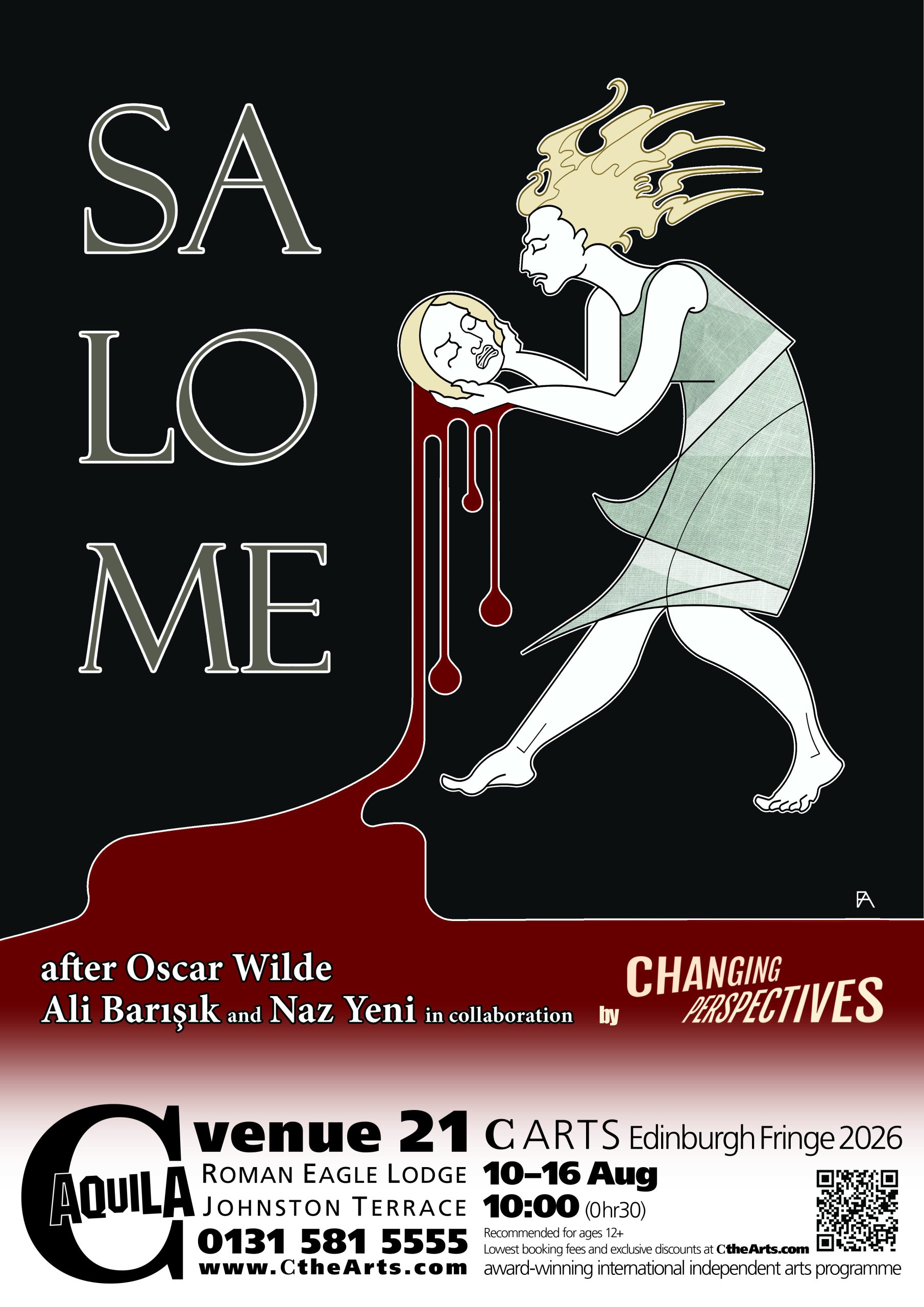
Oscar Wilde’s Salome is one of those stories that has been interpreted countless times. A tale of desire, power, faith and obsession, it has remained relevant precisely because it continues to raise uncomfortable questions about human nature. At the Edinburgh Fringe, Turkish director Ali Barışık approaches the familiar story from a different angle, stripping it down to its essentials and placing a single performer at the centre of the production.
In this significantly shortened adaptation, Naz Yeni performs four characters: Salome, the Soldier, Jokanaan and the Tetrarch. In around 30 minutes, she moves between these roles while the story is largely filtered through the perspective of an older Salome looking back at the events of her youth.
For me, this is where the production becomes particularly interesting.

A familiar story, seen differently
The story of Salome and John the Baptist is well known. The spiritual attraction to the prophet Jokanaan gradually turns into a powerful physical obsession, with consequences that ultimately lead to tragedy.
But in this production, the question is not simply what happened. It is also about how the story is remembered.
Barışık’s direction creates a tension between past and present. Young Salome’s desire, Jokanaan’s rejection, the Soldier’s presence and the Tetrarch’s authority are all brought together through one performer.

@bytvcouk Edinburgh
That decision takes the production away from a conventional character-driven presentation and towards something more symbolic and intimate.
I particularly appreciated the fact that Salome does not attempt to explain everything to the audience. Given its short running time, the production could easily have become overly compressed or rushed. Instead, it leaves certain spaces open, allowing the audience to make their own connections.
Naz Yeni carries the production
A one-person production places enormous responsibility on its performer. Here, Naz Yeni is not simply playing Salome; she takes on four different roles and carries the dramatic weight of the entire piece.
The challenge is not only to portray different characters, but to make those transitions clear enough for the audience to immediately understand who they are watching.
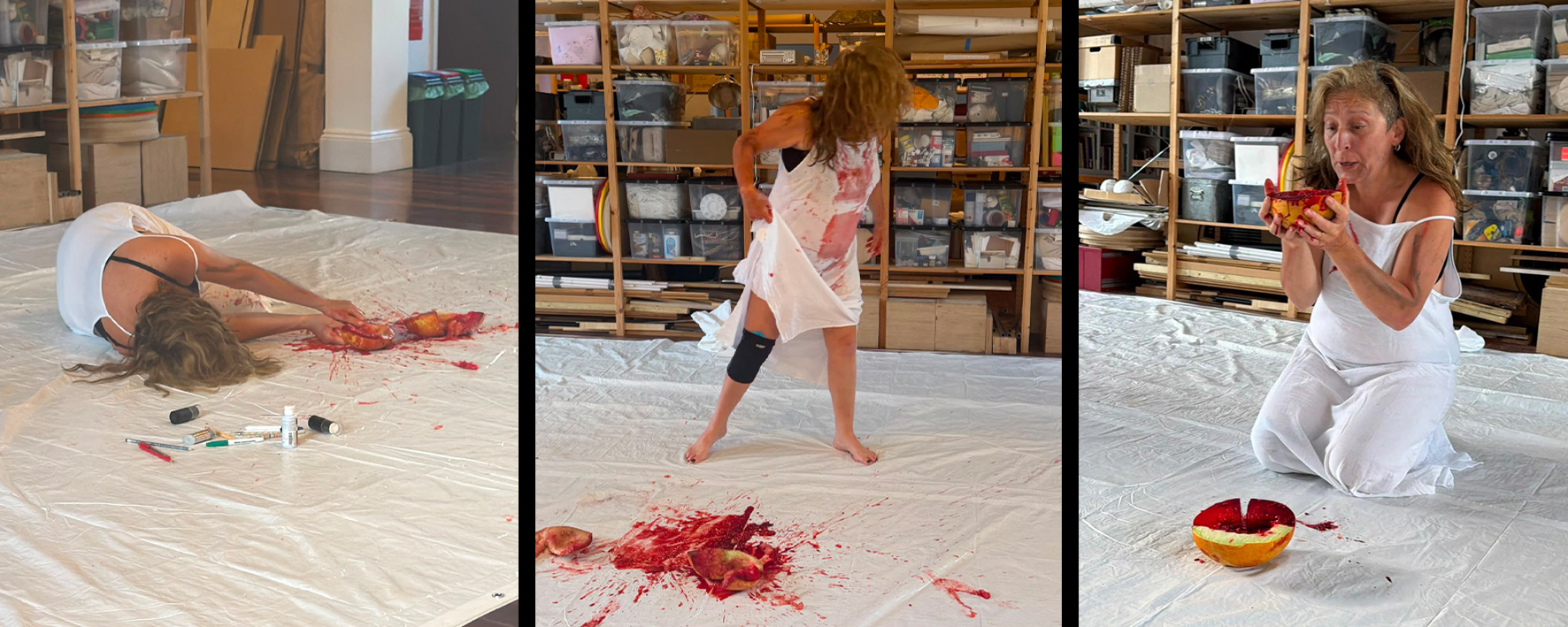
Five characters played by a single actor under the direction of Ali Barışık.
Yeni’s performance works particularly well when the physical and psychological differences between the characters become clear. Her ability to shift between them gives the production its rhythm and keeps the story moving despite its deliberately restricted format.
For that reason, I would not describe Salome simply as another adaptation of Wilde’s text. It is also a concentrated exploration of performance, transformation and perspective.
Naz Yeni completed her acting training at Ankara State Conservatory in Turkey and Birmingham School of Speech and Drama in the UK. She has worked as an actor and director in theatre and performance for more than 30 years, with her acting career including work with City of Birmingham Touring Opera and her directing experience including Ankara State Theatre. Yeni currently continues her work as an academic and researcher at Anglia Ruskin University.
Barışık’s relationship with classical theatre
Ali Barışık’s background adds another layer to the production.
Barışık is an Associate Professor and a full-time faculty member at Mimar Sinan Fine Arts University, Istanbul State Conservatory, Department of Theatre, where he teaches Acting, Role Analysis and Directing.
His professional relationship with the United Kingdom began during his student years. He was accepted into the Work Experience programme at the Royal Shakespeare Company and later appeared as an actor in the BBC Radio 3–RSC production Regime Change. During the same period, he also attended acting classes at RADA.
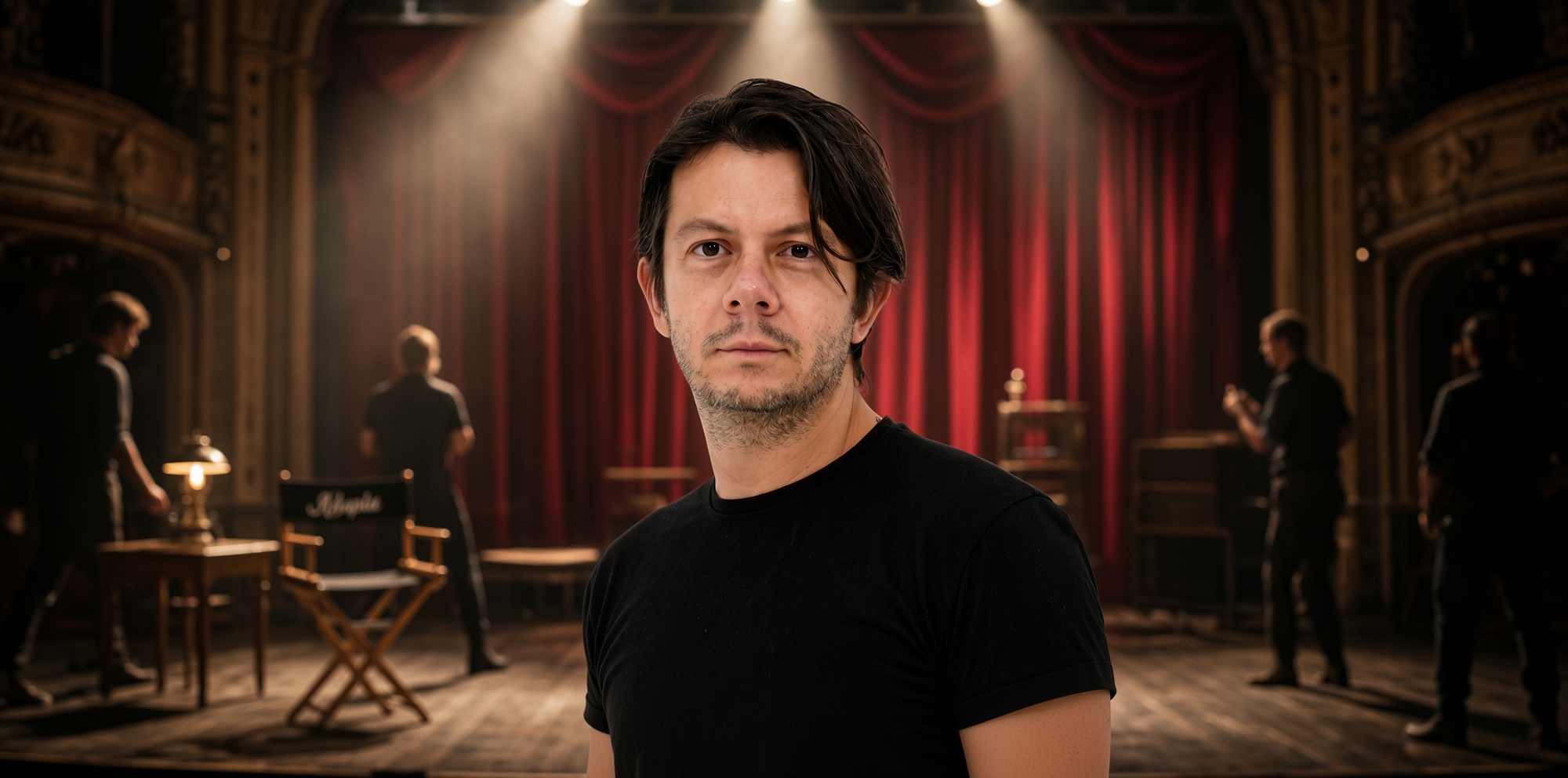
Ali Barışık
He subsequently completed his undergraduate, master’s and doctoral studies before working as a director at the Turkish State Theatre. He currently directs Hamlet, Richard III and Much Ado About Nothing, all of which continue to be performed.
It is difficult to say exactly how this British theatre experience has shaped Salome, but his long-standing relationship with classical texts is certainly relevant. There is a clear interest in finding new ways of presenting established works without losing their dramatic core.
A compact production with its own identity
Salome does not rely on a large cast or an elaborate production. Instead, it puts its emphasis on performance, atmosphere and the relationship between the actor and the text.
The decision to have one performer play four characters is its most distinctive creative choice. Combined with the short running time, it creates an intense and concentrated theatrical experience.
For me, the real strength of Salome is not simply that it retells a story audiences already know. It encourages us to consider whose eyes we are seeing the story through.
At a festival as crowded and unpredictable as the Edinburgh Fringe, where thousands of productions compete for the audience’s attention, a small-scale work that establishes its own language within half an hour can make an impression.
Salome chooses concentration over spectacle. It takes a familiar story, reduces it to its essential elements and asks the audience to look at it from a different perspective.
And sometimes, in theatre, that is precisely where the power lies.
Article: Ergin Balabeyoglu

 By
By 











Comments